By
UPDATED 1 HR 41 MIN AGO

A US military helicopter flies over the …
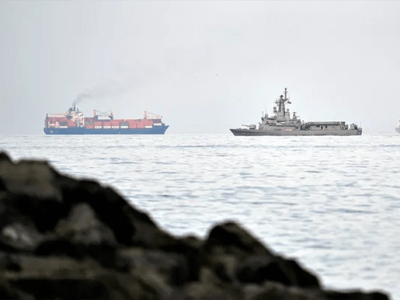
The US is pursuing a vessel in international waters near Venezuela on Sunday after attempting to intercept it, a US official said, as President Donald Trump’s administration tightens its crackdown on the country’s oil industry.
The tanker, called Bella 1, was sailing toward Venezuela to pick up oil. It is under US sanctions for links to Iranian oil. American officials view it as part of the shadow fleet that transports oil from sanctioned nations, and a warrant had been issued for its seizure.
When US Coast Guard personnel attempted to board the ship, however, the vessel kept sailing, the official said, leading to the pursuit.
ANNONS
The official spoke on the condition of anonymity to discuss an ongoing operation.
“The United States Coast Guard is in active pursuit of a sanctioned dark fleet vessel that is part of Venezuela’s illegal sanctions evasion,” a second US official said. “It is flying a false flag and under a judicial seizure order.”
It was the second operation in the same number of days meant to interdict tankers tied to Venezuelan oil. On Saturday, the US Coast Guard intercepted the Centuries tanker in international waters off the coast of Venezuela.
A White House spokeswoman, Anna Kelly, said it was carrying sanctioned Venezuelan oil, though the ship itself did not appear on a list of sanctioned vessels.
Homeland Security Secretary Kristi Noem, whose agency includes the Coast Guard, posted a seven-minute video to social media Saturday afternoon showing a helicopter hovering over the tanker. She wrote that the tanker was apprehended in “predawn action” by the Coast Guard with support from the Defense Department and that it was last docked in Venezuela.
“The United States will continue to pursue the illicit movement of sanctioned oil that is used to fund narco terrorism in the region,” she said.
The US seized a large oil tanker called the Skipper, which had been under sanctions for its ties to Iran, on December 10.
The interceptions mark an escalation in Washington’s efforts to squeeze Venezuelan leader Nicolas Maduro, who Trump has accused of flooding the US with illicit drugs and migrants.
Blockade
Last week, Trump ordered a “complete” blockade of sanctioned tankers going in and out of Venezuela as he looks to cut of Caracas’ main economic lifeline.
Venezuela sits on the world’s largest proven oil reserves, but its output is well below capacity due to international sanctions.
Trump has taken a major interest in the country’s oil, and accuses Venezuela of “stealing” American property in its state takeover of the industry in the 1970s.
Before then, American firms were active in oil drilling in Venezuela. Now, only one US firm — Houston-based Chevron — drills in Venezuela.
Most of Venezuela’s oil is sold to China; the cargos aboard the Skipper and Centuries was ultimately destined for Asia, US officials have said previously.
Venezuela has slammed the blockade, calling it “a reckless and serious threat.” It said it would continue to defend its sovereignty and national interests.
After the seizure of the Centuries on Saturday, Venezuelan Vice President Delcy Rodríguez said in a statement the country “rejects the theft and hijacking of a new private vessel transporting Venezuelan oil” and that it “will take all appropriate actions, including reporting this to the United Nations Security Council, other multilateral organizations, and the governments of the world.”
China has also criticized the US action.
“The US’s arbitrary seizure of foreign vessels is a serious violation of international law,” Chinese foreign ministry spokesperson Lin Jian told reporters at a regular briefing on Monday.
“Venezuela has the right to independently develop mutually beneficial cooperation with other countries,” Lin added.
Shipping data
The unsanctioned Centuries tanker seized on Saturday was carrying 2 million barrels of crude oil, according to Matt Smith, head US analyst at energy consulting firm Kpler.
“It didn’t have its AIS (Automatic Identification System) switched off because it supposedly – it assumedly didn’t think it was under threat of being seized because it isn’t a sanctioned tanker,” Smith told CNN, referring to the transponder system used globally by large ships.
Kpler analysis showed that the Centuries vessel had most recently loaded crude oil at Jose Oil Terminal, Venezuela’s main maritime hydrdocarbon facility, just days before it was seized.
Satellite imagery reviewed by Kpler showed that the vessel had departed Venezuelan waters and was observed approximately three miles south of Grenada, consistent with a voyage toward Asia.
CNN has reached out Centuries Shipping in Hong Kong, who own the Centuries vessel, and has not received a reply.
The impact on global oil prices is likely to be muted because the crude oil tankers that the US are targeting mostly go to China.
“There’s a lot of Venezuelan crude that is already sat offshore China right now.” Smith said. “So, there’s somewhat a bit of an excess there because China is the only market that will take this crude in a similar way to – they’re the only ones that take Iranian crude.”
Meanwhile the Bella 1, the vessel the US is pursuing, was “in ballast,” with no cargo loaded, according to Smith. AIS data showed the vessel signaling for Curaçao, with its last known position recorded offshore of Antigua and Barbuda four days earlier.
Bella 1 was sanctioned by the US Treasury’s Office of Foreign Assets Control (OFAC) in June 2024 for its alleged involvement in Iranian oil transport and is currently listed by the IMO as having a missing flag.
ANNONS
Prior to crossing the Atlantic, Bella 1 loaded crude oil at Kharg Island in Iran in early September. The vessel switched off its AIS in the Strait of Hormuz prior to loading, a common tactic observed among vessels loading sanctioned Iranian crude, with satellite imagery confirming the operation, according to Kpler.
This story has been updated with additional information.
CNN’s Sandi Sidhu and Alessandra Freitas contributed to this report.







 Parazonn